Voita Electronic Voita Electronic

What Is an LED Driver and How Does It Work?

Time:2026-10-02 Author:Madeline
0%

An LED Driver is the control center behind many modern lighting systems. It converts incoming electrical power into a stable supply that LEDs can use safely. Unlike traditional bulbs, LEDs do not simply accept unlimited current. Excess current can create heat, reduce brightness, or damage the light-emitting components.

The basic task sounds simple. It is not. A driver may convert alternating current from a wall outlet into controlled direct current. Some models also regulate voltage, limit current, and protect against surges or overheating. For example, a ceiling fixture may receive 120 or 230 volts, then deliver a carefully controlled output to a small LED circuit. A 12-volt LED strip usually needs a different driver from a constant-current downlight.

A reliable explanation must distinguish constant-current and constant-voltage designs. Constant-current drivers suit LEDs with specified operating currents. Constant-voltage drivers suit products designed around fixed voltages, such as many strip lights. Using the wrong type can cause flickering, premature failure, or unsafe temperatures. It can also make troubleshooting confusing.

Look closely at the label. Input range, output current, voltage, wattage, dimming method, and safety certifications all matter. Heat also matters. A driver installed inside a sealed ceiling space may perform differently from one mounted in open air. In practical testing, a multimeter can confirm output readings, but professional electrical work should follow local requirements and manufacturer instructions.

There is no universal driver.

Understanding how an LED Driver works helps readers choose compatible equipment, interpret symptoms, and avoid guesses. Still, real installations vary. Even a technically correct explanation may need revision when load size, wiring length, ventilation, or dimmer compatibility changes.
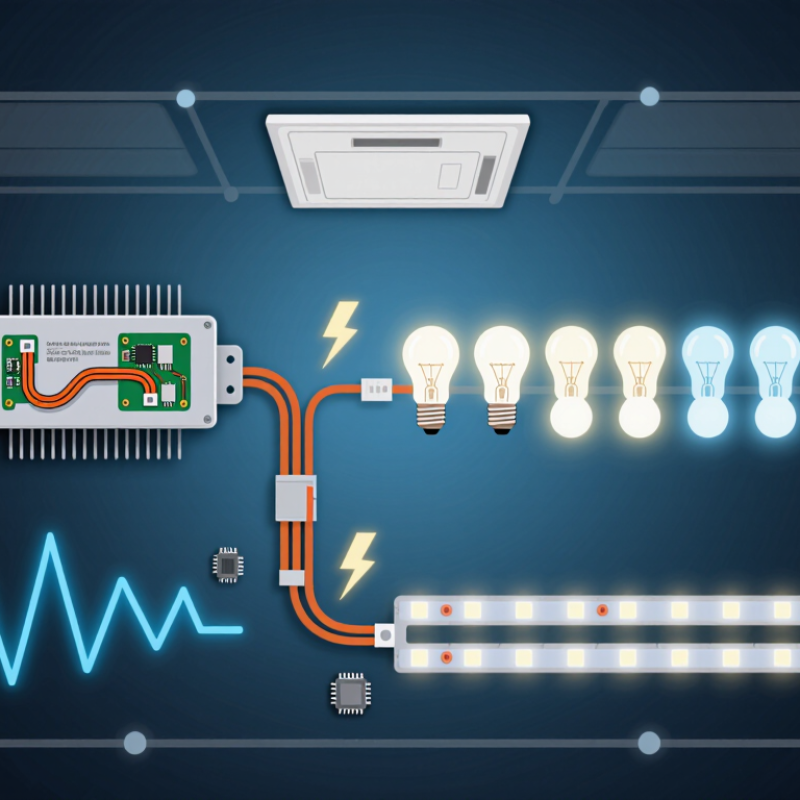
What Is an LED Driver and How Does It Work?

LED Drivers: Definition, Purpose, and Core Functions

What Is an LED Driver and How Does It Work?

An LED driver is an electronic device that controls power for an LED light source. LEDs need stable current, not simply direct connection to a wall outlet. The driver converts incoming electricity into a controlled output that the LEDs can safely use. It may change voltage, limit current, and reduce electrical fluctuations. Without this control, LEDs can flicker, overheat, or fail much earlier than expected.

Its core functions include current regulation, voltage conversion, dimming control, and protection. A constant-current driver suits LED modules that require a fixed current. A constant-voltage driver supports systems designed for a specific voltage, such as certain light strips. The driver may also protect against short circuits, overheating, and sudden power changes. In practical installations, technicians check output ratings, ambient temperature, enclosure space, and cable length before selecting a driver. Small details matter. A loose connection can create heat that remains hidden inside the housing.

A driver’s purpose is not only to turn lights on. It helps maintain consistent brightness and supports reliable service over time. However, rated performance can change in warm or poorly ventilated spaces. A design may look correct on paper and still fail in a hot enclosure. This is where careful testing becomes important. Measure the output under load, inspect connections, and allow space for heat dissipation. The component is easy to overlook. That can be the mistake.

How an LED Driver Regulates Power for Stable Lighting

An LED driver is the control unit between the power source and the LED module. It converts incoming electricity into a controlled current or voltage. This regulation protects the LEDs from surges, heat, and unstable mains power. Without it, brightness may fluctuate, components may age quickly, or failure may occur. The driver matters.

In practical installations, a constant-current driver adjusts output so each LED receives a predictable current. Sensors and feedback circuits can also correct changes caused by temperature or input voltage. You may notice this during commissioning: a poorly matched driver can create flicker, uneven dimming, or a faint buzzing sound. These details are easy to miss. A technical review by the U.S. Department of Energy found laboratory LED efficacies above 200 lumens per watt, although complete luminaires usually achieve less after optics, thermal losses, and electronics are included. Stable power helps preserve that performance over time.

Efficiency is increasingly important because the International Energy Agency has reported that lighting uses roughly 15% of global electricity consumption. A well-designed driver reduces conversion losses and supports reliable dimming. It must also match the LED module’s current range, thermal conditions, and control method. In field work, specifications do not always predict real behavior; cable length, enclosure heat, and installation quality can change results. Small errors accumulate. The useful lesson is simple: driver selection is not an accessory decision. It is part of lighting design itself.

Key Components and Operating Stages Inside an LED Driver

What Is an LED Driver and How Does It Work?

Key Components and Operating Stages Inside an LED Driver

An LED driver regulates electrical power so LEDs receive controlled current, not simply a fixed voltage. This matters because small current changes can cause heat, color shifts, or early LED failure. Inside the enclosure, the input stage commonly uses a fuse, filter, rectifier, and surge protection. The fuse limits damage during a fault. The filter reduces electrical noise. The rectifier converts alternating current into pulsating direct current. In low-voltage systems, the input may already be direct current, so this section is simpler.

The switching stage controls energy transfer at high speed. A controller drives a switching transistor, while an inductor and capacitor smooth the resulting waveform. Current-sensing resistors measure output flow, and feedback tells the controller when to adjust switching time. This closed-loop action keeps LED current stable as input voltage and temperature change. Some drivers isolate the output from the mains through a transformer. Others use a non-isolated design, which can be smaller but requires careful insulation.

During operation, protection circuits monitor overloads, short circuits, overheating, and abnormal input voltage. Thermal components may reduce current before the housing becomes dangerously hot. Real installations are less perfect. Wiring resistance, poor ventilation, and aging capacitors can alter performance. A reliable evaluation checks ripple, output current, temperature rise, and startup behavior under load. One overlooked detail can matter. Engineers should compare measurements with the LED module’s specifications, rather than relying only on the driver label.

What Is an LED Driver and How Does It Work? - Key Components and Operating Stages Inside an LED Driver

Operating Stage Key Component Primary Function Electrical Principle or Typical Data Contribution to LED Operation Common Design Consideration
1. Input Protection Fuse, surge suppressor, and EMI filter Limits damage caused by excessive current, voltage surges, and conducted electromagnetic interference at the input. A fuse opens the circuit during a sustained overcurrent. A surge suppressor absorbs short-duration voltage transients, while the EMI filter uses inductors and capacitors to reduce unwanted noise. Improves electrical safety, reliability, and electromagnetic compatibility before power reaches the conversion stage. Protection ratings must match the input voltage, expected fault current, surge environment, and applicable safety requirements.
2. Rectification Bridge rectifier Converts alternating-current input into a pulsating direct-current waveform. A four-diode bridge provides full-wave rectification, so both half-cycles of an AC input contribute to the DC bus. Creates the DC source required by the switching converter in an AC-input driver. Diode forward loss, reverse-voltage rating, thermal dissipation, and inrush current must be considered.
3. Energy Storage and Smoothing Bulk electrolytic capacitor Stores energy and reduces the voltage ripple produced by rectification. The capacitor charges near the peaks of the rectified waveform and supplies energy between peaks. Ripple generally increases as load current increases or capacitance decreases. Provides a more stable DC bus for the switching stage and helps prevent excessive input-frequency flicker. Capacitance, ripple-current rating, voltage rating, temperature rating, lifetime, and inrush current are important.
4. High-Frequency Switching Power switch and gate-drive circuit Rapidly connects and disconnects the input energy to control the amount of power transferred to the output. Power switches operate at a high switching frequency using pulse-width modulation or a related control method. The duty cycle influences the average transferred energy. Enables a smaller magnetic component and efficient regulation compared with a purely linear current-control approach. Switching losses, conduction losses, gate timing, voltage overshoot, heat removal, and electromagnetic noise require careful design.
5. Energy Conversion Transformer or inductor Transfers and stores energy while converting voltage and current to a level suitable for the LED load. Flyback, buck, boost, and buck-boost topologies are commonly used. A transformer can provide galvanic isolation; an inductor generally does not. Sets the basic relationship between the input voltage, output voltage, output current, and isolation requirement. Core material, winding loss, saturation current, insulation system, leakage inductance, and operating frequency affect performance.
6. Secondary Rectification Output diode or synchronous rectifier Converts the high-frequency AC or switched waveform into a unidirectional output current. A diode conducts during the appropriate portion of each switching cycle. Synchronous rectification replaces the diode with a controlled switch to reduce conduction loss in selected designs. Delivers usable DC power to the current-regulation stage and LED load. Reverse-recovery behavior, forward voltage, switching speed, current rating, and thermal performance influence efficiency.
7. Output Filtering Output inductor and capacitor Reduces switching ripple and smooths the current delivered to the LEDs. The inductor resists rapid changes in current, while the capacitor reduces voltage variation. The required filtering depends on topology, switching frequency, and LED-current ripple limits. Helps maintain stable LED current, lower optical ripple, and reduced electrical stress on the LED assembly. Excessive capacitance can affect control-loop stability, startup behavior, and output response.
8. Constant-Current Regulation Current-sense resistor and control IC Measures and regulates the LED current rather than simply regulating output voltage. A common relationship is ILED ≈ VSENSE / RSENSE, where VSENSE is the controller’s current-sense threshold. Maintains consistent LED brightness and helps prevent excessive current caused by LED forward-voltage variation or temperature changes. Sense-resistor tolerance, sensing noise, control-loop response, minimum operating voltage, and current accuracy are key factors.
9. Feedback and Isolation Feedback network, reference, and optional optocoupler Communicates output-current or output-voltage information to the controller so it can correct changes in load or input conditions. In an isolated driver, an optocoupler or an isolated feedback device transfers the regulation signal across the safety barrier. Improves line regulation, load regulation, current accuracy, and protection response. Feedback compensation, isolation distance, signal noise, response speed, and failure behavior must be evaluated.
10. Dimming Control PWM, analog, or digital dimming interface Adjusts perceived light output while maintaining controlled LED operation. PWM dimming changes the proportion of time the LED is on. Analog dimming changes the regulated current level. Digital interfaces may configure current, timing, and fault behavior. Allows brightness adjustment for lighting controls, displays, sensors, and energy-management systems. Dimming frequency, minimum dimming level, start-up behavior, flicker performance, and control compatibility are important.
11. Protection and Fault Handling Overcurrent, overvoltage, short-circuit, thermal, and open-load protection Reduces the risk of damage during abnormal operating conditions. The controller can reduce power, shut down temporarily, latch off, or restart after a defined delay when a fault threshold is reached. Protects the driver, LED module, wiring, and surrounding equipment from foreseeable electrical and thermal faults. Threshold accuracy, fault-recovery method, abnormal-test conditions, and thermal sensor placement affect system safety.
12. Thermal Management Heat sink, thermal interface, and temperature sensor Transfers heat away from semiconductors and limits operation when internal temperature becomes excessive. Power loss is converted into heat. Junction temperature depends on power dissipation, thermal resistance, ambient temperature, and airflow. Supports efficiency, output-current stability, component lifetime, and safe continuous operation. Layout, enclosure ventilation, thermal interface quality, derating, and LED-module temperature must be considered together.

Constant-Current and Constant-Voltage Driver Designs

What Is an LED Driver and How Does It Work?

Constant-Current and Constant-Voltage Driver Designs

An LED driver controls electrical power before it reaches an LED circuit. It may convert incoming AC or DC power, then regulate voltage, current, or both. The correct design depends on the LED arrangement, rated input, and thermal conditions.

A constant-current driver supplies a controlled current, such as 350 mA or 700 mA. This approach suits individual high-power LEDs and series-connected LED strings. The output voltage changes as the LED forward voltage changes. However, the driver needs enough voltage headroom to maintain stable current. Too little headroom can cause flicker or uneven brightness.

A constant-voltage driver maintains a fixed output, commonly 12 V or 24 V. It suits LED strips, panels, and modules that already include current-limiting components. The connected load then determines the current draw. Exceeding the driver’s rated wattage can create overheating, voltage drop, or premature failure.

Heat matters.

Measure at the load, not only at the power supply. A common bench mistake is ignoring cable resistance over long runs. Dimming also requires attention: PWM and analog methods are not interchangeable across every circuit. In practice, a design can look correct on paper and still perform poorly when airflow, wiring, or temperature changes. Testing under real operating conditions remains essential.

Choosing the Right LED Driver for Different Applications

An LED driver regulates current and converts electrical power for an LED fixture. It protects the diode from voltage changes, overheating, and sudden surges. A reliable driver also controls dimming and reduces visible flicker. Choosing the wrong model can cause buzzing, uneven brightness, or early failure.

The U.S. Department of Energy reports that LED lighting can use at least 75% less energy and last up to 25 times longer than incandescent lighting. The driver strongly influences whether those savings appear in real use.

For residential lighting, choose a compact driver with stable dimming and low standby power. Offices need flicker control, smooth digital dimming, and compatibility with building automation systems.

Outdoor fixtures require sealed housings, wide temperature ratings, and protection against moisture and surges. In wet locations, the enclosure rating matters as much as electrical output. It is an easy detail to overlook.

Industrial spaces often need constant-current drivers with strong thermal protection. High-bay fixtures face dust, vibration, and long operating hours.

The International Energy Agency estimates that lighting consumes about 15% of global electricity, so small efficiency losses can become significant. Check output current, voltage range, power factor, efficiency, and control protocol before installation.

Field experience suggests that installers sometimes oversize drivers for safety, but excessive capacity can reduce efficiency and dimming performance. The “bigger is better” assumption deserves another look.

FAQS

What is an LED driver?

An LED driver controls electrical power for an LED light source. It converts incoming electricity into a usable current or voltage. Direct wall power can make LEDs flicker, overheat, or fail early. The driver is essential.

Why do LEDs need regulated power?

LEDs respond strongly to small current changes. Unstable power may cause uneven brightness, color shifts, or excess heat. A driver keeps output more predictable. I might overlook this during a quick installation.

What is the difference between constant-current and constant-voltage drivers?

A constant-current driver supplies a fixed current to compatible LED modules. A constant-voltage driver provides a set voltage for systems designed around that value. The LED module specifications must match the driver. They are not automatically interchangeable.

How does a driver support stable brightness?

Feedback circuits monitor output current and adjust switching behavior. This helps compensate for input-voltage and temperature changes. A poorly matched unit may cause flicker or uneven dimming. Sometimes, faint buzzing appears.

What components are commonly found inside a driver?

Input sections may include a fuse, filter, rectifier, and surge protection. Switching circuits use a controller, transistor, inductor, and capacitor. Sensing resistors measure output current. Feedback helps maintain stable operation.

How does a driver protect LED equipment?

Protection circuits can respond to overloads, short circuits, overheating, and abnormal input voltage. Some designs reduce current when temperatures rise. This limits stress inside the housing. Protection helps, but it cannot fix every installation mistake.

What should technicians check before selecting a driver?

Check output current, voltage, power rating, control method, and LED compatibility. Consider ambient temperature, enclosure space, and cable length. Inspect connections carefully. A loose wire can create hidden heat.

Why does installation environment affect driver performance?

Warm, poorly ventilated enclosures can raise internal temperature. Heat may shorten capacitor life and reduce rated performance. Measure output under load and check temperature rise. Paper specifications are not always enough. Real conditions can disagree.

Conclusion

An LED Driver is an essential electronic device that supplies and controls the electrical power required by LED lighting. Its main purpose is to convert incoming power into a stable output that protects LEDs from voltage fluctuations, overheating, and excessive current. By continuously regulating power, the driver helps maintain consistent brightness, improve energy efficiency, and extend the service life of the lighting system.

Inside an LED driver, components such as rectifiers, switching circuits, transformers, control chips, capacitors, and protection systems work through several operating stages to deliver controlled power. Constant-current drivers provide a fixed current for LED arrangements that require precise current control, while constant-voltage drivers maintain a steady voltage for systems designed around a specified voltage level. Selecting the right driver depends on factors including LED requirements, input and output ratings, dimming functions, environmental conditions, efficiency, and safety features. Matching these specifications ensures reliable performance for residential, commercial, industrial, and outdoor applications.

Madeline

Madeline

Madeline is a dedicated marketing professional with a wealth of expertise in our company's core offerings. With a keen understanding of the industry, she brings a unique perspective to her role, consistently delivering high-quality content that highlights the superior aspects of our products. As......